

Whether you’re a new pool owner or brushing up on best practices, understanding what chemicals you need for a swimming pool is key to maintaining clean, safe, and sparkling water.
In the UK, where cooler temperatures, rain, and seasonal use affect pool chemistry, getting the chemical balance right helps protect water quality and pool equipment and surfaces.
In this guide, we’ll explain the essential pool chemicals, what they do, how to use them, and how to keep your water in perfect condition all season.
Why Pool Chemicals Are So Important
Pool chemicals do more than keep the water looking clear; they make it safe for swimmers by controlling bacteria, preventing algae, and maintaining the water’s balance to avoid irritation or corrosion.
Without proper chemical treatment, your pool can quickly become a breeding ground for bacteria and algae. Imbalanced water can also damage your liner, stain surfaces, strain filtration and heating systems.
In short, maintaining the proper chemical levels is essential for hygiene, comfort, and longevity. Our team at Aquascapes have been helping homeowners protect their pools for several years. Get in touch if you need any more guidance!
The Essential Pool Chemicals You’ll Need
For a standard domestic pool in the UK, the core set of chemicals includes:
- A sanitiser (usually chlorine or bromine)
- pH adjusters to maintain water balance
- Alkalinity and calcium hardness increases
- A stabiliser to protect chlorine from UV rays
- Shock treatments for deep cleaning
- Algaecides and clarifiers as needed
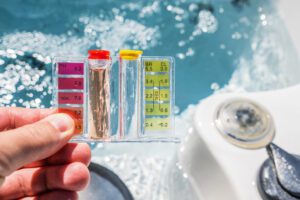
- A test kit or digital tester to monitor chemical levels
These work together to keep your water balanced, sanitised, and visually appealing.
Sanitising Your Pool: Chlorine vs Bromine
Chlorine is by far the most common pool sanitiser in the UK. It kills bacteria and breaks down organic contaminants. You can find it in granular, tablet, or liquid form, and it’s usually added via a floating dispenser or directly to the water.
For outdoor pools, stabilised chlorine is often used to prevent degradation from sunlight.
Bromine is a gentler alternative, often preferred for indoor pools or hot tubs because it doesn’t produce the same pungent odour. It’s more stable at higher temperatures but can be more expensive.
In both cases, you aim to maintain a consistent sanitiser level, typically 1–3 ppm for chlorine or 2–4 ppm for bromine.
Balancing pH and Alkalinity
Your pool’s pH level measures how acidic or alkaline the water is. The ideal range is 7.2 to 7.6—close to the natural pH of human eyes and skin. If the pH drops too low, the water becomes corrosive and irritating. If it rises too high, chlorine becomes less effective, and the water can turn cloudy.
Alkalinity acts as a buffer for pH, helping to prevent sudden changes. In the UK, where rainwater is naturally acidic, it’s common for alkalinity to dip, which then causes unstable pH levels. You should aim for alkalinity between 80 and 120 ppm.
To adjust levels, use a pH increaser (sodium carbonate) or pH reducer (sodium bisulfate) and an alkalinity increaser (usually sodium bicarbonate) if needed.
Managing Calcium Hardness
UK water can vary in hardness depending on your region. Calcium hardness refers to the amount of dissolved calcium in the pool water, with an ideal range between 200–400 ppm.
Too little calcium can cause water to leach minerals from pool surfaces and equipment, leading to corrosion or etching. Too much, on the other hand, can cause scaling and cloudy water.
If your water is too soft (common in parts of the UK), you may need to add a calcium hardness increaser to protect your pool’s structure.

Protecting Chlorine with a Stabiliser (Cyanuric Acid)
For outdoor pools, chlorine can break down quickly under UV light. A chlorine stabiliser, also known as cyanuric acid (CYA), slows this process, giving your sanitiser more staying power.
You only need a small amount, typically 30–50 ppm—but be careful not to exceed this, as too much CYA can reduce chlorine effectiveness. Stabilised chlorine products (like dichlor or trichlor) often include CYA, so monitor levels if you use them regularly.
Indoor pools generally don’t require stabilisers due to the lack of direct sunlight.
Additional Chemicals for Peak Pool Performance
Beyond the core chemicals, a few extras can help keep your water clear and healthy, especially during warmer months or busy periods.
Shock treatments are high-dose chlorine treatments that oxidise organic waste and restore water clarity. They are used weekly during the summer or after a heavy bather load or rainstorm.
Algaecide helps prevent or treat algae blooms, especially in outdoor pools exposed to sunlight. It’s a preventive measure but shouldn’t replace your regular sanitiser.
Clarifiers bind tiny particles into larger ones, making them easier for the filter to remove. These are helpful if your water looks cloudy despite balanced chemistry and a clean filter.
How to Test Your Pool Water Accurately
Testing your pool water is the only way to know what adjustments are needed. In the UK, it’s recommended to test at least twice a week during the summer and weekly during cooler months or periods of low use.
You can use:
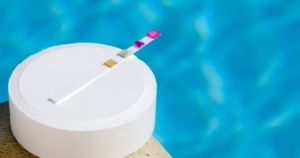
- Test strips – Quick and easy, though less precise
- Liquid drop test kits – More accurate for detailed readings
- Digital pool testers – Fast, reliable, and increasingly affordable
- Regular testing helps prevent imbalances before they become costly or hazardous.
Do Above-Ground Pools Need the Same Chemicals?
Yes, above-ground pools require the same chemical treatments as inground ones. However, they tend to have smaller water volumes, so chemical dosing needs to be more precise.
Because of their construction, above-ground pools may benefit from softer chlorine dosing methods and gentle algaecide treatments to avoid damaging liners.
Always read product labels for appropriate dosage based on pool size, and test regularly to avoid over-treating.
Get Expert Chemical Advice from Aquascape
Where to start, or what your pool needs? At Aquascape, we offer tailored advice, professional water testing, and access to premium chemical products to keep your pool in perfect balance.
Our team can help you:
- Identify the exact products your pool requires
- Set up a simple maintenance routine.
- Diagnose and correct water quality issues.
- Avoid common mistakes like overdosing or chemical interactions.
Whether you’re maintaining your pool yourself or want expert help, Aquascape is here to make it easier and safer to enjoy your pool all year round. Get in touch for more information!
Frequently Asked Questions
What chemicals do I need to add to a new pool?
You’ll need a sanitiser (chlorine or bromine), a pH and alkalinity balancer, a calcium hardness increaser (if needed), and a stabiliser for outdoor pools. Test water before first use.
How often should I add chemicals to my pool?
This depends on pool usage and weather, but most UK pools require chemical checks and adjustments 1–2 times per week and a weekly shock treatment during peak season.
Can I mix pool chemicals?
No. Always add chemicals separately, with time between treatments. Mixing them, especially in their concentrated forms, can be dangerous.
Do indoor pools need different chemicals than outdoor ones?
The core chemicals are the same, but indoor pools generally don’t need a stabiliser (CYA) and may benefit from using bromine instead of chlorine.
How do I safely store pool chemicals at home?
Keep chemicals in a cool, dry, well-ventilated area from direct sunlight. Store them in original containers away from children and pets, and never mix different products.

